Friday, December 23, 2011

Heirloom Week: Lebkuchen

 If any cookie spells tradition in the Brick house, it's a lightly-spiced 'gingerbread' cookie I first tasted at a coffee bar in Nuremberg, Germany, back in my college years. Lebkuchen may remind you of molasses cookies, but they're really a mix of honey, ground nuts and the ginger-related spices. In old times, monks would mix old honey (at least 6 months fermented) with flour, and let the mixture mellow for a few months before baking the cookies. I've tried this, as well, with success. So if your time is limited right now (who's isn't?), mix up the dough, then put it in the freezer. Roll out the cookies a month or two from now, instead, and enjoy them during a winter snowstorm. They're incredible, and worth the extra work.


LEBKUCHEN
(Thanks to Epicurious for this basic recipe)

INGREDIENTS
For nut flour
  • 3/4 cup hazelnuts (3 1/2 oz)
  • 3/4 cup sliced almonds (2 1/2 oz)
  • 2 3/4 cups all-purpose flour
  • 3 tablespoons unsweetened cocoa powder
  • 1 tablespoon ground cinnamon
  • 1 teaspoon ground ginger
  • 1/2 teaspoon ground cloves
  • 3/4 teaspoon salt
  • 1/2 teaspoon baking powder
  • 1/4 teaspoon baking soda

For cookies
  • 1 cup packed dark brown sugar
  • 3/4 cup mild honey
  • 1/2 stick (1/4 cup) unsalted butter, softened
  • 2 large eggs
  • 1/2 cup finely chopped fine-quality mixed candied fruit such as citron, orange, and lemon*
  • 4 (11 1/2- by 8 1/4-inch) sheets edible rice paper, cut with scissors into 32 (2 1/2-inch) rounds

For icing
  • 2 cups confectioners sugar
  • 3 tablespoons water
HOW TO MAKE THEM:

Make nut flour:
Finely grind nuts with remaining nut flour ingredients in a food processor.
Make dough:
Beat together brown sugar, honey, and butter in a large bowl with an electric mixer at medium-high speed until creamy. Add eggs 1 at a time, beating well after each addition. Mix in nut flour at low speed until just blended, then stir in candied fruit.
Preheat oven to 350°F.
Arrange rice-paper rounds, shiny sides down, on 2 large baking sheets. Roll level 2-tablespoon amounts of dough into balls with dampened hands, then put 1 on each paper round and flatten slightly (dough will spread to cover paper during baking).
Bake cookies in upper and lower thirds of oven, switching position of sheets halfway through baking, until surface no longer appears wet, about 15 minutes total. Transfer to racks to cool.
Ice cookies:
Sift confectioners sugar into a bowl, then stir in water until smooth. Evenly brush tops of cooled cookies with icing. Let icing set, about 1 hour. 

* Available at Fauchon (212-308-5919) or The Baker's Catalogue (800-827-6836).
Cooks' note: • These cookies improve with age but icing will darken. If making ahead, do not ice until day of serving. Cookies keep, layered between sheets of wax paper, in an airtight container 1 month. 
   Editor's note: Instead of rice paper, the Germans use a round edible disk I heard described as 'gebaken.' Feel free to substitute these, instead. The cookies are also wonderful iced with melted bittersweet chocolate.


Lebkuchen hearts, Santas and other shapes are a favorite at
'Christ Kindl Markts' in Austria and Germany. Photo from Wikipedia; read more about Lebkuchen's origins here.

Thursday, December 22, 2011

Heirloom Week: Yule Log

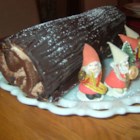
The French know it better as "Buche de Noel," a rolled sponge cake confection that's frosted roughly to resemble 'bark,' then decorated with meringue mushrooms, candies...or in this case, gnomes!


 It was one of Julia Child's favorite Christmas desserts on her PBS cooking shows. For one episode, she planned to stick lit Fourth of July sparklers into her cake, just before serving it. The only problem -- the cake hadn't come out well, so they'd frosted a copy of the local newspaper, instead. When she pushed the sparklers in, they bent double and bounced back! (A quick sign-off on that one.)

Marzipan fruit and other shaped goodies make a nice addition, and are more readily available this time of year, especially at places like Trader Joe's or Cost Plus Imports. This quick lesson on Yule Logs may also be helpful before you start cooking:


BUCHE DE NOEL
(thanks, Allrecipes.com)

Ingredients

  • 1/2 cup sifted cake flour
  • 1/4 cup unsweetened cocoa powder
  • 1 teaspoon baking powder
  • 1/4 teaspoon salt
  • 1/2 cup white sugar
  • 3 eggs, separated
  • 1/4 cup milk
  •  
  • 1/8 cup confectioners' sugar
  •  
  • 1 1/2 cups whipped cream
  •  
  • 2 cups heavy whipping cream
  • 8 (1 ounce) squares semisweet chocolate, melted
  • 1/4 cup butter, softened
  •  
  • 1/8 cup confectioners' sugar
  • 1/2 teaspoon green food coloring
  • 8 ounces marzipan

Directions

  1. Preheat oven to 350 degrees F (175 degrees C). Grease a 15x10-inch jelly roll pan. Line with waxed paper. Grease paper.
  2. Sift together flour, cocoa, baking powder, and salt.
  3. Beat together sugar and egg yolks at high speed until light and fluffy. At low speed, alternately beat milk and flour mixture into egg mixture.
  4. Using clean beaters, beat egg whites at high speed until stiff, but not dry, peaks form. Fold one third of beaten whites into batter. Fold in remaining whites. Spread batter in prepared pan; smooth top.
  5. Bake cake at 350 degrees F (175 degrees C) until set, 12 minutes.
  6. Dust a clean cloth with confectioners' sugar. Turn cake out onto prepared cloth. Remove waxed paper. Trim cake edges. Starting with a long side, roll up cake, jelly-roll style. Transfer, seam-side down, to a wire rack to cool for 30 minutes.
  7. Unroll cake; remove cloth. Spread whipped cream over cake to within 1 inch of edges. Re-roll cake. Place, seam-side down, on serving plate.
  8. To prepare frosting, in a small saucepan, bring heavy cream, melted chocolate, and butter to a boil over medium heat, stirring vigorously until blended. Remove from heat. Let stand until set. Spread frosting over top and sides of cake.
  9. To prepare garnish, dust work surface with confectioners' sugar. Knead food coloring into marzipan until blended. Using a rolling pin dusted with confectioners' sugar, roll marzipan to a 1/8-inch thickness. Using a small knife, cut out leaves. Arrange leaves, cinnamon candies, and snowmen on top of cake and around plate. Dust with confectioners' sugar.                                


Wednesday, December 21, 2011

Heirloom Week: Gingerbread Houses

Any kid, whatever age, would appreciate a spicy, crunchy house on the sideboard, just waiting for post-Christmas munchies. The best place on the 'Net to learn about this art is Ultimate Gingerbread, a website that will help build your own place, from getting out the ginger to frosting that final brick.It also helps you submit your creation for any number of contests!

Here's a basic recipe to get you started. (Thanks, Ultimate Gingerbread.)


Debbie's Gingerbread House Dough Recipe

Comments from Debbie:  I have made a gingerbread house every Christmas since I graduated from college in the late 70s. At first I used to make them and take them home for my cousins to decorate and eat. Then they became great masterpieces that looked like the house I was living in and they had stained glass (lollipop) windows and lights inside (an old Christmas tree bulb rigged up on a cord with a plug). Now I make a house every November with my kids, before the seasonal preparations get too crazy. We put all our leftover Halloween candy on the houses (a great way to use it up!). We have a tradition of having a house eating party on New Years Day, when we invite the neighbor children to sit in the backyard with our kids and break apart the house and eat whatever part they want. Its pretty gross and dusty at that point but it doesnt seem to matter. They never eat that much of it anyway but it is fun to break it apart! This recipe makes a good crisp cookie that smells delicious baking and gets very hard for good strong walls. It hardly puffs at all so you will keep good definition in window holes and doors.

Mix together:
  • 6 3/4 cup flour
  • 1 Tbsp cinnamon
  • 1 1/2 tsp ginger
  • 1/2 tsp salt
Stir together over medium heat till margarine is melted:
  • 1 1/2 cups Karo Syrup
  • 1 1/4 cup brown sugar
  • 1 cup margarine

Add to the flour mixture and blend till the dough is easy to handle, I do it in my Kitchenaid mixer. It's a firm dough and gets harder as it cools. I like to roll it out while it's still warm!
Cut out a front/back wall and a side wall shape from paper. Use the top edge of each of those 2 pieces to make a roof piece, it should be a little bigger so it hangs over the walls. Now line your cookie sheet with heavy duty foil (moisten it to keep it from sliding), spray very lightly with Pam spray, roll 2 1/3-3 cups dough 1/4" thick, use paring knife to cut around shapes and peel scraps off sheet. Cut windows and doors. Leave 1/2" minimum between pieces. Bakes at 350 12-15 minutes, cool on foil. If it puffs at all, you can trim around the windows or edges to make the lines square while it is still hot out of the oven. Once it cools, it is very hard.


Windows (lollipop mixture)
bring to a boil:
  • 1 cup water

remove from heat. Add and stir till dissolved:
  • 2 cups sugar
  • 3/4 cup light Karo corn syrup
  • 1 Tbsp butter

Return to heat. When boiling cover about 3 minutes so the steam can wash down crystals. Uncover and cook at high heat without stirring to 300. Take off heat and let the bubbles subside.

Very carefully spoon or pour mixture into window holes. BE CAREFUL THIS IS VERY HOT AND STICKY. ONLY GROWNUPS DO THIS PART. Have ice water handy in a bowl for emergency first aid. Can be colored but is naturally a nice light amber color.
Royal Icing
  • 2 Tbsp meringue powder (available at cake decorating supply store)
  • 1/3 cup water
  • 1/4 tsp cream of tartar
beat till foamy
add:
  • 1 lb. powdered sugar
Beat till stiff and white on high speed for about 5 minutes. Keep bowl covered with a damp towel when not in use. Can be thinned slightly and tinted for spreading to Paint@ a wall. I like to put in a pastry bag and pipe it onto the joints of the house with a star tip #16. Hold the walls in place with cans and bottles from the cupboard. Let the walls dry overnight before you put on the roof.
Let the roof dry overnight before you start putting on the candy. Walls can be decorated before they are put together, let them dry overnight. I put a light on the tray and tape it down before I start construction, then build the house around the cord. Put anything inside the house..like an ice cream cone spread with green icing and covered with sprinkles (for a Christmas tree) or little pieces of lace (on either side of the windows for curtains) before you put the roof on top. Coconut tinted green (shake it in a zip lock bag with green food color and 2 tsp water, spread it out on a cookie sheet to dry) makes great grass, or leftover white frosting makes good snow piled in drifts against the house, or dripping from the roof in icicles. Cookies and cereal and sticks of gum and necco wafers make a great roof. I love this site, what a great place to share ideas! Good Luck! And have fun!

Monday, December 19, 2011

Heirloom Week: Stollen

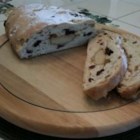
Germans everywhere would be unhappy with me, if this holiday favorite wasn't included. It's heavy on the dried fruit...and at least to this palate, resembles the Italian Panettone, although it's a different shape. (Deutschers and Italians everywhere, please don't hurt me for saying so!) Try it sliced and toasted, with a light slathering of real butter, for your Christmas morning breakfast.

This recipe is courtesy of AllRecipes.com, and comes via a professional baker. It's a bit different, for the surprise marzipan center -- omit it, if you don't care for almonds.


HOLIDAY STOLLEN

Ingredients

  • 1 tablespoon active dry yeast
  • 2/3 cup warm milk (110 degrees F/45 degrees C)
  • 1 large egg
  • 1/3 cup white sugar
  • 1/2 tablespoon salt
  • 1/3 cup butter, softened
  • 2 1/2 cups bread flour
  • 1/3 cup currants
  • 1/3 cup sultana raisins
  • 1/3 cup red candied cherries, quartered
  • 2/3 cup diced candied citron
  • 6 ounces marzipan   (omit this, if not interested)
  • 1 tablespoon confectioners' sugar
  • 1 teaspoon ground cinnamon

Directions

  1. In a small bowl, dissolve yeast in warm milk. Let stand until creamy, about 10 minutes.
  2. In a large bowl, combine the yeast mixture with the egg, white sugar, salt, butter, and 2 cups bread flour; beat well. Add the remaining flour, 1/4 cup at a time, stirring well after each addition. When the dough has begun to pull together, turn it out onto a lightly floured surface, and knead in the currants, raisins, dried cherries, and citrus peel. Continue kneading until smooth, about 8 minutes.
  3. Lightly oil a large bowl, place the dough in the bowl, and turn to coat with oil. Cover with a damp cloth and let rise in a warm place until doubled in volume, about 1 hour.
  4. Lightly grease a cookie sheet. Deflate the dough and turn it out onto a lightly floured surface. Roll the marzipan into a rope and place it in the center of the dough. Fold the dough over to cover it; pinch the seams together to seal. Place the loaf, seam side down, on the prepared baking sheet. Cover with a damp cloth and let rise until doubled in volume, about 40 minutes. Meanwhile, preheat oven to 350 degrees F (175 degrees C).
  5. Bake in the preheated oven for 10 minutes, then reduce heat to 300 degrees F (150 degrees C), and bake for a further 30 to 40 minutes, or until golden brown. Allow loaf to cool on a wire rack. Dust the cooled loaf with confectioners' sugar, and sprinkle with the cinnamon.


Heirloom Week: English Christmas Cake

The Brits are passionate about their Christmas cake, a almost-white, almost-fruitcake concoction heavily frosted with thick icing. Miss Read, one of my favorite 'cosy' authors, is forever having her heroines add frosting holly and robins on top! (Maybe yours truly, being a Coloradoan, should add frosting magpies, instead.)

Serve your cake at Christmas tea, along with a good English Breakfast or Prince of Wales cuppa, and you'll be in with the best of 'em. (Maybe even listen to the Queen's annual address, while you sip and crunch.)

This version is adapted from Tasha Tudor's TAKE JOY, a wonderful compendium of recipes, stories and crafts that celebrate the holiday season. Tasha had a thing about candied fruits, and LOVED her butter intake. I'm not fond of greasy pools spreading over the baking pan, so adapted that. Add a cup of candied fruit to this recipe if you're a fruitcake-lover. 

CHRISTMAS CAKE (Colorado style)
1 1/2 cups butter
1 1/2 cups sugar
8 eggs (no, I'm not making this up)
1 cup chopped almonds, pecans, filberts (your choice)
4 tablespoons orange juice (I also grate a bit of the orange rind in)
2 teaspoons vanilla
1 teaspoon salt
2 teaspoons baking powder
5 cups flour (make this 5 heaping cups if you're cooking at high altitude)
1 cup 'craisins' (dried cranberries -- or substitute raisins, if you like them)
1 cup halved maraschino cherries

Cream butter and sugar together. Add the eggs, one at a time, mixing as you go, then the other ingredients -- stop before the flour. (It's easiest with two people, but one can manage just fine.) Stir in the flour, a cup at a time, then add craisins and cherries. Mixture will be very thick.
Line your pans with foil -- I can generally get a 10" springform pan, plus 3 or 4 little patty pans out of this, but you might prefer two round cake pans or an angel cake-type pan (the kind with a funnel in the middle). You'll get approx. two round cake pans, or a round (or loaf) pan plus the angel food cake pan. Now 'glop' the mixture into the pans, smoothing on top when they're done. (About half-full)

Bake at 275 degrees for approx. an hour -- my 10" springform took 1 1/2 hours because it was so thick. Cake is done when it's firm in the middle...test by gently pushing against it, or using a toothpick poked in. (Clean means it's done.) Let cool in pans, then fold foil over and store in a cold place for at least a week. (Tasha does it for months, but I have had these spoil when held that long.) Frost with confectioner's sugar, or serve as-is with tea. (The Brits like to add a layer of almond paste on top, then frost it.)
Makes one good-sized cake for you and your dinner companions -- plus a cake for a friend. Intensely rich and memorable.

One sad year, I made a double batch of Christmas cake. It turned out beautifully. I put all of the cakes in a heavy box 'safely' on the back deck. They were -- for about a week. The night before Christmas, they all disappeared...with only a few delectable crumbs left. So if you're stashing your cake, make sure it's protected!


Sunday, December 18, 2011

Heirloom Week: Panettone

PANETTONE 
 
Thanks to Mangio Bene Pasta for this beloved old Italian recipe! 

Panettone  (Makes 1 large bread)
1 (1/4 ounce) package dry  yeast
1/4 cup warm water (110 - 115 degrees F)
1/2 cup flour

2/3 cup golden raisins
1/4 cup
grappa or brandy
5 tablespoons butter, room temperature
2 eggs
4 egg yolks
3/4 cup sugar
1/4 cup warm water  (110 - 115 degrees F)
1 tablespoon vanilla
4-1/2 to 5 cups flour
Grated zest of 1 orange
Grated zest of 1 lemon
1/2 cup chopped candied citron


To make the starter dough, or sponge, dissolve the yeast in 1/4 cup warm water in a bowl.
Add 1/2 cup flour and stir to make a very loose dough.
Cover the bowl with a towel of plastic wrap and let rise in a warm place for at least 6 hours or overnight.
In another bowl, combine the raisins and grappa, and let them soak for at least 6 hours or overnight.

In a large bowl, combine the butter, eggs, yolks, sugar, 1/4 cup warm water, and vanilla.
Drain the soaked raisins in a strainer set over a bowl; press with a spoon and set aside.
Add the liquid to the egg mixture.Add the starter dough and mix well.
Gradually add the flour, mixing with your hands until a soft dough forms.
Transfer the dough to a lightly floured surface and knead until smooth and elastic, about 10 minutes. Add more flour as needed.
Butter a large bowl, place the dough in it and turn once to coat both sides with the butter.
Cover with a towel or plastic wrap and let rise for 6 hours in a warm place.

Butter and flour a panettone mold or other deep mold that is about 6 inches tall and 8 inches wide.
Punch down the dough and transfer it onto a lightly floured surface. Flatten the dough into a large rectangle.
Evenly distribute the orange and lemon zest, raisins, and citron over the dough.
Fold the dough in half to enclose the fruit and knead to distribute the fruit throughout the dough.
Place the dough in the prepared mold, cover with a towel, and let rise for 45 minutes in a warm place.

Preheat the oven to 375 degrees F.

Cut an X in the top of the dough with a sharp knife.
Bake for 15 minutes.
Reduce the heat to 350 degrees F.
Continue to bake for 30-35 minutes or until a skewer inserted in the middle comes out clean.
Place the bread on a rack to cool for 30 minutes before removing it from the mold.
Be sure that the bread has cooled completely before wrapping it for storage.

Saturday, December 17, 2011

Heirloom Week: Sachertorte

This coming week will feature Christmas desserts that have been especially popular over the years -- classics that have come to represent the holidays for their fans. Today: Sachertorte.

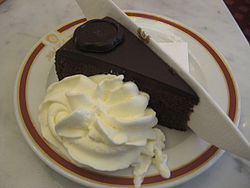
One of the things I brought home after a college summer spent in Austria and Germany was a recipe for Sachertorte. This dense, chocolately "cake" uses breadcrumbs, and has a layer of apricot jam between its layers. Then another layer of chocolate is brushed all over the cake. The whole thing is served with a puff of whipped cream ("schlag," unsweetened, if you're doing it the Austrian way) to cut all the richness.
   
According to Wikipedia, "In 1832, Prince Wenzel von Metternich charged his personal chef with creating a special dessert for several important guests. The head chef having taken ill, let the task fell to his sixteen-year-old apprentice, Franz Sacher, then in his second year of training with Metternich's kitchen. The Prince is reported to have declared, "Let there be no shame on me tonight!" While the torte created by Sacher on this occasion is said to have delighted Metternich's guests, the dessert received no immediate further attention."
    Sacher finished training as a chef, and eventually opened a specialty deli in Vienna. It was his oldest son Eduard, however, who made this cake famous, when he served it at the Demel Bakery, and later at the Hotel Sacher, which he founded in 1876. Since then, the Sachertorte has remained one of Austria's most famous foods.
    Don't let all this fancy rigamarole fool you -- the Sachertorte is actually quite simple to make. It's easiest if you do it in steps -- bake the layers in the morning, then assemble and frost the cake in the afternoon. (Or do it successive days.)  The Brick version has two changes: we substitute raspberry jam for apricot, and the finished cake has a rimmed edge of chopped nuts, preferably filberts.
    There's no better dessert with a cup of coffee or tea. It's the kind of dish meant for a long leisurely talk after supper, with your daughter gleefully spearing the last nutty bits off your plate, and everyone laughing about what the dog did that morning.


photo courtesy of Wikipedia; read more about it here.

SACHERTORTE

1 6-oz pkg chocolate chips (or equivalent fine chocolate bar - the darker, the better)
1/2 cup butter
8 eggs (separate into yolks and whites)
3/4 cup sugar
1 teaspoon vanilla
1/2 cup fine dry breadcrumbs
3/4 cup flour

Melt chocolate chips and butter in the microwave (approx. 1 1/2 min.) In the meantime, get out your commercial mixer and start beating the egg WHITES until they're stiff. (Make a peak when you stop the mixer and lift the blade up.)

By hand, mix the egg yolks and sugar in a separate bowl #2, add the melted chocolate mixture, then gently fold in the vanilla, breadcrumbs and flour.

Add the stiffened egg whites (gently) to bowl #2, then pour mixture into one greased tube pan, springform pan, or two 9" layer cake pans. Bake at 350 degrees for 30 min. (9" pans) to 60 min. (tube or springform) -- cake will be done when firm to the touch, and an inserted toothpick comes out dry. Let cool, then gently release from the pan.

FILLING & GLAZE

1/2 cup apricot jam (the traditional -- strawberry or any red berry works, too)

1 6-oz. pkg chocolate chips (or equivalent bar)
1 tablespoon butter
1 tablespoon coffee
1/2 teaspoon vanilla
2 tablespoons milk or sour cream

Set the jam aside. Microwave everything else until melted (about 1 1/2 min.)

If your cake was baked in a tube or springform pan, slice it in half horizontally. (This is easier to do if it's cool.) Spread jam between layers and-resandwich.

Spread the melted chocolate mixture on top of the cake, taking care to frost around the sides, as well. Keep the top as glossy as possible. (Easiest way to do this is to take a knife dipped in hot water and smooth the top after the chocolate has been iced.)

The traditional finishing was to write 'Sacher' on top in chocolate icing -- but I generally spread chopped nuts on top or the sides. (Filberts are the traditional choice, but who cares.)

Makes 12 slices of incredibly decadent cake. Serve with strong coffee or espresso mit schlag.